Thursday, November 5, 2020

2019 - 2020 Update

Sorry for the lack of updates, we have been busy out at Kumeu as always, after testing out the QHY Cold CMOS camera for Astronz, the Auckland Astronomical Society approved the purchase of a 16' GSO Ritchey-Chrétien telescope, we got the new scope onto the mount with the help of Grant Christie, Jonathan Green and Steve Hennerley, the brand new Astronz 40cm Ritchey-Chrétien astrograph is a significant upgrade for the observatory. It is named the "Menzies Telescope" in memory of Barry and Trixie Menzies, both long term members of the Society and both with a lifelong passion for astronomy. Unfortunately Barry passed away in 2014, and Trixie in 2018.

Sadly the collimation of the new telescope was quite far out and we never quite got it right before we started the 2019 Microlensing campaign, despite this our photometry was deemed useable and we proceeded to grab data on as many events as the weather allowed for, at this point we had a few new young society members who were keen to learn the ropes (literally in the case of having to open and close the dome which is on a rope pully system), Sasha Green, Tony Cooper, Janine Lawton and Andrew Marmont all attended mutliple nights of observering during 2019, our stand out moment came when in the late stages of the 2019 Microlensing campaign Andrew Marmont serendipitously discovered a plantery signal while taking normalizing data on an alert that had been called off, it was lucky he was manning the telescope that night because if Jonathan had been their he would probably have been on the priority target instead and we would have missed it, the signal was confirmed by the KMT survey with a 2x Earth mass planet thought to have caused the signal, so the entire Kumeu team was very excited with the news of the exo-planets detection, we are currently still awaiting a paper to be written for this event.

In 2020 sadly our work horse camera the ST-10XME CCD developed a fault that could not be fixed, the council has approved the purchase of a new camera and in the meantime we are borrowing Guy Thornley's SBIG ST-7XME, we only managed to get this camera on the telescope near the end of the 2020 Microlensing campaign but we did manage to cover a few events, the camera has a tiny field of view but we can plate solve and get good photometry so it's more than up to the task for the kind of work we do.

^ The field of view of the SBIG ST-7XME we can't even fit all the sculptor galaxy into our narrow field of view!

There wasn't as many alerts in 2020 this is probably due to the Covid-19 pandemic which is still raging across the world, we did manage to get the collimation looking much better in 2020, so our stars look much more round now, although the collimation can still be improved for sure, we are now looking forward to buying a new camera and to the 2021 Microlensing campaign, we will work over the summer on maintenance of the site and continue to teach new team members from the Auckland Astronomical Society who are keen to learn how to operate the equipment, with an active team of observers including AAS members that enjoy using the site to setup their own telescopes the future is looking bright for the Kumeu Observatory!

Monday, June 18, 2018

Progress at Last!

Over the last couple of weeks we've had some great progress at Kumeu Observatory, firstly Jonathan Green managed to get hold of the electrician and get the power restored, then with a stroke of luck on our side we had a decent run of clear weather around full Moon, so taking advantage of the clear weather Jonathan Green and Steve Hennerley managed to get the new QHY 168c Cold CMOS camera which is on loan from Astronz installed and in focus which was a bit of a mission, Steve had to 3d print a spacer to get enough back focus but we got there in the end.


<- The new QHY 168C Cold CMOS camera with a QHY 5 II offset autoguider currently on loan to Kumeu Observatory thanks to Astonz.


On one of the days Jonathan met up with Steve out at Kumeu he took a look into the neighbouring Wasp Observatory after all the storms we have had out at Kumeu, Auckland Astronomical Society member Nicola Gujer had asked him to check up on her gear in the observatory. On opening the door to the observatory Jonathan was confronted by a rather large rat! After scaring off the rat, Jonathan had a chance to inspect the observatory, unfortunately the observatory was in quite a state with rat excrement everywhere and a strong smell of rat urine. So after heading home Jonathan sent David Moorhouse an e-mail advising him of the situation at the Wasp, after talking on the phone David and Jonathan met up out at the Wasp on the weekend and thoroughly cleaned and disinfected the entire observatory, after this task was completed Jonathan had a chance to talk with David about the future of the Wasp Observatory, David indicated that he had no plans to come back to Astronomy and indicated that he wished to sell his equipment, so now the Auckland Astronomical Society council will discuss the potential purchase of Davids equipment at the next council meeting, hopefully we can come to an agreement to buy Davids equipment and get the observatory back into regular operation.


<- David Moorhouse inspects his equipment after cleaning up the rat infestation.


<- NGC 4945 captured from Kumeu Observatory, please note the collimation of the telescope had not been refined at this stage, although preliminary tests were encouraging to say the least.


The Trifid Nebula captured from Kumeu Observatory on the 8th of June, please note the collimation of the telescope had not been refined at this stage. ->


^ And finally on Thursday the 14th of June Steve Hennerley met up with Jonathan Green to work on refining the collimation of the 12' Astronz (GSO) Ritchey–Chrétien telescope, unfortunately the sky had clouded over by the time we were happy with the preliminary collimation, so we still need to put the telescope on a star and see if we will need to make any final adjustments. The weather has been quite frustrating since last Thursday but hopefully we get another clear patch soon, so we can continue the great progress that has been made so far.


Posted by Jonathan Green

Tuesday, May 15, 2018

Storms and Setbacks

Sorry for the lack of updates, it turns out that the Ritchey–Chrétien telescope we installed had faulty optics so we ended up replacing that with another mirror cell that seems to be fine, we have also had a couple of nasty storms in Auckland recently, the first storm knocked the power off when a tree fell over the power cable that connects the observatory to the power grid and the second one damaged the shutter of the dome, the observatories neighbour Peter McLeod repaired the shutter quickly and for free which was very much appreciated by the Auckland Astronomical Society council, Peter has now also repaired the Dome from the rotting skirting and the mold and moss growing on the dome exterior the dome also has a nice new shiny paint job now.


<- Steve Hennerley and Andrew Buckingham replacing the faulty optics in the Ritchey–Chrétien telescope.


Moving forward we are looking to get the power restored then testing out the new optics with a new QHY ColdCMOS camera on loan from Astronz, hopefully we should be back in action soon.


<- Despite all the setbacks the one really positive thing that has been accomplished this year is the repair and restoration of the Kumeu Observatory dome, Peter McLeod did an exemplary job.


Posted by Jonathan Green


Monday, January 29, 2018

Update.

Sorry for the lack of updates recently, we had an extended microlensing season this year, our last microlensing target for the year was in Taurus and we took observations of that target throughout November, December and early January, we encountered all the usual challenges with frosting on the chip causing some frustration and missed nights, also during November we had a broken computer network so observations had to be taken using the computer in the dome which is never ideal, the target in Taurus was also fairly low in the sky for us, so not sure if our observations will be useful or not, although Subo Dong told me he was giving our data to his student to work on so we can only hope he can extract some useful data out of it and that Kumeu Observatory will get a mention in any papers written, we did have a pretty good run of weather during November and December so we managed to monitor the target with a daily cadence on almost every available clear night, including a lovely clear Christmas morning.

January hasn't been as good weather wise so far, it's been very hot with temperatures in the 18-20 degree range at night, our SBIG CCD can't cool down to -20 in these conditions, also means that the mosquito population has exploded so we either sweat it out inside the observatory or get eaten alive outside, work on the repairs to the dome have commenced with Peter constructing some scaffolding on the outside of the observatory, we also had an issue with the shutter when the elastic guide rope snapped one night when Jonathan Green was opening up giving him a fright.


<- The Dome scaffolding in place ready for the repair work.


Now that the microlensing observing campaign has finished, Jonathan Green, Steve Hennerley and Andrew Buckingham headed out in the daytime to take off the "Nustrini" C14 Schmidt-Cassegrain telescope and replaced it with a Astronz GSO 12' Ritchey–Chrétien telescope, we are going to have to find an adapter for the Optec Temperature Compensating Focuser and we will have to spend a few clear nights working to get everything setup and operational again, if the tests from the new optical tube are positive we may ask the council to purchase either a 14' or a 16' Ritchey–Chrétien telescope for the observatory as the "Nustrini" is really getting quite old now and is due for retirement.


We also repaired the elastic guide rope for the shutter and replaced the last two old filters in the filter wheel of the SBIG CCD camera so we now have an all new LRGB set as well as a new Wratten 12 filter, with the councils consent Jonathan Green and Steve Hennerley also removed the bunk beds downstairs to make more room for an observation workstation, we are very happy to have done this as on removal we found Rat feces and urine marks in both beds and really those beds were a health hazard, there is also evidence that Rats have been getting into the roof of the observatory but with a pig farm on one side and a macadamia nut farm on the other we are probably always going to have a rodent problem, all we can do is set rat baits and hope to control the problem as best we can.


<- The downstairs room with bunk beds removed, plenty of space now for an observation workstation to be installed


So we still have plenty to do out at Kumeu, Andrew Buckingham also has a QHY ColdCMOS camera for us to try out although it's yet to arrive in New Zealand, we will need to work on the RC's collimation, do another pointing model, take flats, work out our pixel scale, field of view etc etc so plenty to keep us busy over the coming months, bring on the clear skies!

Posted by Jonathan Green

Wednesday, October 25, 2017

Focus Issue Resolved

Jonathan Green, got out to Kumeu Observatory last week in an attempt to resolve the focus issues he reported last time he and Shaun Fletcher were out there, after consulting Grant Christie about the issue he came armed with some new settings to try, once he had inputted the new settings the TCF auto-focus worked and the camera didn't stop anymore although he still couldn't run through a v-curve due to not having enough steps to get through, in other words the auto-focus was hitting the step number 1 before completing the v-curve, so knowing that the solution for that is to set the TCF back to 3500 which is the halfway point and then manually focus the telescope until it's back to near focus, once that was completed getting the v-curve was simple and getting a decent focus was not a problem.

Of course to manually focus the telescope he had to un-lock the primary mirror so we will probably need to re-collimate the telescope, also by moving the mirror this has also shifted the T-Point model so we will need to do another pointing model as well, knowing that we also need to take the camera off the telescope to remove the old Wratten and luminance filters and replace them with the new filters provided to us from Astronz Jonathan decided to not attempt another T-Point model until the new filters had been installed, of course there was also plenty of clouds around on the night that also influenced his decision to not attempt a new pointing model as well.

Unfortunately Jonathan discovered a new issue on the night with our computer network, the computer downstairs won't communicate with the dome PC anymore or go online, so we can't currently check the cloud sensor online at the moment, Steve Hennerley is back from overseas now so after having a chat with him over the phone we diagnosed the problem and Steve is going to purchase the replacement parts to get the network back up and running.

Now that Steve is back in New Zealand we are going to spend some time this Spring / Summer really optimizing all our systems at the observatory including our Polar Alignment, the tracking speed of the mount, collimation and a few other jobs that we were putting off while the microlensing season was still underway, we also have been granted a budget from the council of the Auckland Astronomical Society to employ our observatory neighbour Peter McLeod to undertake repairs to the dome's base ring and skirting as well as cleaning and re-painting the dome, we get our mains power from Peters house so it's great that we have someone so close to us that is prepared to undertake all the work that needs to be done to restore the observatory to it's former glory, again a huge debt of thanks is owed to Steve Calveley for suggesting to us that Peter could do all the work that was needed and of course for letting us operate the Kumeu Observatory on his land.


<- As you can see from this photo of a Moon halo above the Kumeu Observatory, the dome is really in dire need of a good clean and re-paint!


Posted by Jonathan Green

Wednesday, September 20, 2017

Focus Issues

Last night was the 1st good night in a while so Jonathan Green and Shaun Fletcher headed out to Kumeu so Shaun could get some practice in, unfortunately we had an issue with the Optec TCF focuser, basically it would start the auto-focus run take one or two images and then just inexplicably stop, also at times it would try to move the focus to some crazy step number size like around the 200,000 mark when the maximum step size is of course just 7,000, I was at a loss to explain this strange behaviour as no settings have been changed in the downtime between clear skies and it was working perfectly fine the last time I was out there, so we tried shutting everything down a number of times to see if maybe we had done something wrong in the setup procedure but nothing seemed to work and we were hit with the same problem every time we got to the auto-focus process, thankfully we have an Auckland Astronomical Society council meeting tonight so I'll be able to ask Grant Christie about the problem and see if it can be resolved, I'm sure it must be something simple that is just eluding me at the moment.

Last night we also had a few visitors to the Observatory we had a local Kumeu astrophotographer who is just 16 years old come and take a small tour of the Observatory with his Dad, we encouraged them to join the society and to visit Stardome where they will be able to actually "look" through a telescope, we also had two society members use the observatory grounds as a dark site to do some deep sky astrophotography from, so it was a busy night out at the observatory indeed! Even though it was really a very frustrating night for myself.


<- Robert Patterson setting up his imaging rig

Posted by Jonathan Green

Monday, August 28, 2017

And Then There Were Three

Last week and over the weekend we had a couple of good nights, so with no current alerts on, Jonathan took the opportunity to complete Shaun Fletcher's training, now there are three people who are capable of operating the setup in the main dome of Kumeu Observatory, we will still be looking to train more members of the Auckland Astronomical Society so that we can ensure that the observatory will never become disused and derelict again.

Speaking about derelict, Jonathan Green also met up with the treasurer of the society Niven Brown on Sunday afternoon to show him the damage to the dome that Steve Hennerley had discovered before he went overseas, basically we have a bit of rot on one side of the dome, probably because the skirting was never replaced and is inadequate to protect the under side of the dome from the elements, David Moorhouse had mentioned this problem to Bill Thomas last time he saw him in the city, Niven took some photos of the damage and will circulate them to the council, so hopefully with the consent of the council we will be able to hire a builder to come fix the problem, we also want to get the dome cleaned up as well seeing as it looks quite grubby with loads of moss and mold on the outside of the dome, it will probably need treating with a chemical wash and perhaps could be re-painted afterwards as well.


< Screen shot of an image of the Trifid Nebula that I'm working on in PixInsight, I'm still learning how to use PixInsight but it's a fantastic program and I can really see why Rolf Wahl Olsen gets such great results using it.

Posted by Jonathan Green

Saturday, August 5, 2017

Internet and a Few Good Nights.

Sorry for the lack of updates, since you last heard from us, we now have the internet out at Kumeu Observatory thanks to Steve Hennerley, we also had a number of good nights last weekend, we didn't have any current Microlensing alerts on, so Jonathan invited Auckland Astronomical society members Shaun Fletcher and Carolle Varughese over to learn the basics of MaxIm DL, Shaun having his own home observatory and being an Astrophotographer picked it up really quickly and Carolle having studied Astronomy and having done a years worth of observations at Mt John Observatory also picked it up quickly, so we probably only need a few more nights of training to get these two up to speed, with no current Microlensing events to follow we do need to start thinking about new projects to tackle.

Another issue that has been discovered with the amount use of the dome is now getting is that the fibreglass sides are starting to really degrade and will require some maintenance, we will be bringing this up at the next society council meeting to hopefully devise a plan of action to repair the dome and perhaps even get the dome cleaned and painted at the same time as it's quite grubby after all these years.


<- M8 The Lagoon nebula captured and processed by Shaun Fletcher at Kumeu Observatory.


Posted by Jonathan Green

Friday, July 21, 2017

Crisis.....Averted... (but a lost night...)

On Tuesday 18th July, Jonathan headed out to the observatory to find beautifully clear skies perfect for some follow up imaging.  After getting set up and ready to grab some data, the remote connection to the dome PC from the bunkroom suddenly failed.  Checking upstairs the dome PC was no longer powered up - and - even worse, wouldn't actually power up.

Even the IT support favourite advice of "turn it off and turn it on again" (well unplug it completely) did not manage to solve the issue.  Unable to contact Steve initially, Jonathan headed out to make the most of the clear skies with some DSLR astrophotography.

The following night Jonathan and Steve managed to hurry along the Auckland Astronomical Society council meeting members with a view to getting out of the meeting and up to the observatory as quickly as possible - with a spare computer power supply in hand.

Almost as expected (remember Murphy?).. the PC powered up instantly...

The challenge was working out WHY the PC had failed because having unreliable equipment is certainly going to have a negative effect on our efforts.  Out came the power supply tester (Steve's a professional IT nerd so has these things lying around...) and everything looked good... fearing the worst... the "intermittent problem"... Steve reconnected everything and powered up again to start some additional diagnostics.

One common cause in the PC world when something goes off suddenly and won't power back up (even with a "power cycle") - but then does some time later (maybe many minutes later) - is that there has  been a short circuit, power surge or "overcurrent" problem somewhere on the motherboard or power supply.  Most IT techs have seen this most often when an errant screw accidentally makes its way (purely by itself you understand) onto the exposed boards of a PC.  The protection circuity (such as polyfuses) kick in and power is removed.  It is common not to instantly come back on when the fault is removed.
OB171186_170719

The hunt was on - for insects in the power supply, "errant screws", possibilities of electrical surge (though the surge protector was still functioning).  Nothing was obvious ... so case back on and stand the PC back up.

At that point the probably cause of the issue was suddenly staring us in the face... the bright blue power LED (which is normally covered loosely with black electrical tape) was off... whilst the PC was on.  Jonathan was certain the light was on the night before when he was setting up and checking inside again, it was still connected.

It seems likely that the blue LED had failed, which in turn had tripped protective circuitry on either the motherboard or the power supply.  The mystery solved, we could be a lot more confident it wasn't going to happen again, and we took the opportunity to do something that should have been done when Steve built the PC - disconnect the Hard Disk and  power lights completely to protect the darkness of the dome.

With that resolved, and the skies clearing, Jonathan and Steve set out to grab some images of a new high priority microlens target OB171186.  Joanathan managed to get 28 300 second images over the next couple of hours - though had a few problems - the strange and as yet undiagnosed mount disconnection (from an earlier blog post) and an issue plate solving a number of (most of) the images in PinPoint.

Light Curve from OB171186
Steve processed the images next day for upload and managed to get the astrometric solution by reducing the number of star used for the solve and also narrowing the intensity range used for matching in the PinPoint settings.  This seemed to do the trick.  Steve also ran the images through a tool called PySIS - which uses differential image analysis to generate a photometric light curve.

Posted by Steve Hennerley


Monday, July 17, 2017

Action Stations!

OB171317
On Saturday the 15th of July Jonathan Green and Steve Hennerley were at Kumeu Observatory, after some advice from Grant Christie that the microlensing target OB170019 was still viable, we took just over an hour's worth of data on the target, Grant had advised that we didn't really need any more than an hour so we were kind of stuck for new projects as there had been now new microlensing alerts for a while, that day Jonathan Green had signed up for the Center for Backyard Astrophysics (CBA) in the hopes of finding some more projects to take on, he had copied down a few Cataclysmic Variable targets to attempt to image, so we attempted a few of the targets but found that each of them was only just above the noise level, so not knowing if that would be useful or not we decided to take more images of OB170019, unfortunately the clouds started rolling in about this time and we couldn't guide for 5 minutes anymore so we decided to pull the plug on the night and headed home with the idea of doing some research and finding some new projects to pursue when we don't have any more microlensing work to do.

On Sunday the 16th of July we finally had a new microlensing alert so it was action stations! Only one problem the forecast for that night was for increasing clouds! We decided to give it a go anyway and just hope for the best, Steve arrived 1st and found the sky was half clear and thankfully our target was on the clear side, so he opened up the dome and got to work, he captured 14 300 second exposures of our target OB171317 before Jonathan arrived, after a few cloudy patches we got back to work but it was slow going with passing clouds causing our guide star to fade more often than not, Steve headed home and Jonathan stayed on to keep imaging for as long as possible, we got to 27 300 second exposures of our target OB171317 although thin clouds may have affected a few of them.
Jonthan imaged the target when gaps allowed until 1:30 am when this cloud bank appeared in the West, it didn't take long after this photo was snapped for the cloud bank to move over our target and even though Jonathan stayed on at the observatory until around 3 am he never saw another opportunity to collect more data, so after calibrating the data we had collected he headed home and sent the files to Steve for submission to MicroFUN, hopefully we get a few more breaks in the clouds tonight to grab our normalizing data as apparently our target has already faded considerably.


Posted by Jonathan Green

Tuesday, July 11, 2017

Cloudy Nights at Kumeu

Since the last night imaging at Kumeu, we have had a run of some really bad weather, on Sunday the 9th after attending Neil deGrasse Tyson at Spark Arena I headed out to the observatory in the hope of clear skies but even with other parts of Auckland clear Kumeu was still under a pretty constant blanket of clouds, after waiting I drove home to find Coatesville clear but you could still see major clouds in the West. On Monday the 10th after attending the Auckland Astronomical Society meeting I headed out again in the hope of clear skies but it was raining on arrival so I attempted to wait out the clouds and rain by occupying myself with cleaning up the observatory but with no luck it was still heavy cloud when I left around midnight, I'm happy to report we have submitted all our current data to MicroFUN so all we need now is some clear sky to get back to work although fortunately there has been no new microlensing alerts in the meantime.


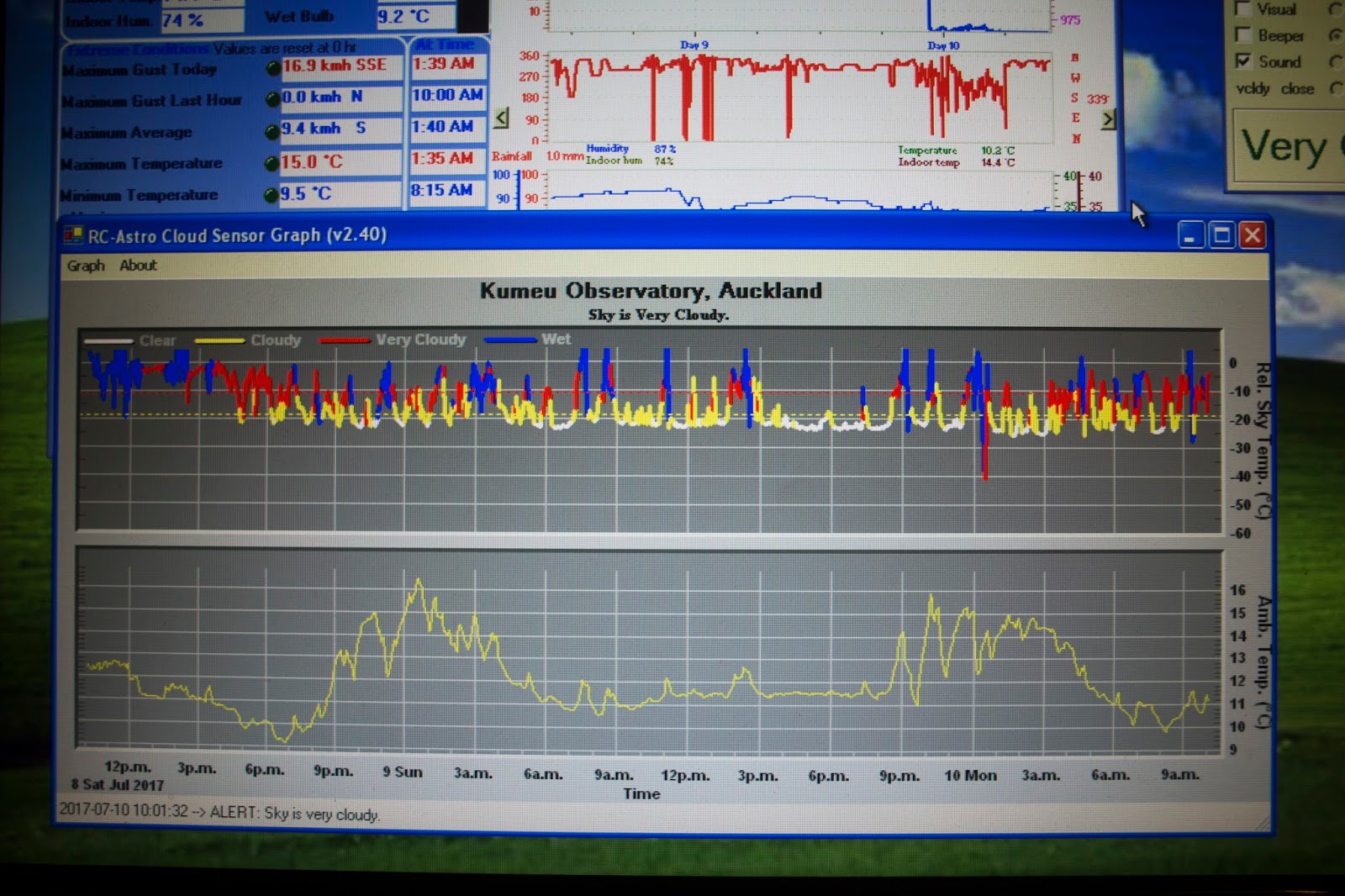
^ As you can see from this image of the cloud sensor graph clear patches have been few and far between, it's been frustrating because other parts of Auckland have looked relatively clear.

Posted by Jonathan Green

Tuesday, July 4, 2017

A Night of Two Halves

On Monday the 3rd of July, Jonathan Green decided to miss going to the Auckland Astronomical society meeting and head out to Kumeu instead, after a weekend of rain and clouds it looked like things were finally clearing up, after arriving around 6:15pm he opened up the dome setup and got a focus of a FWHM of 1.7 arc seconds per pixel ( not bad for having only just opened the dome ), he then got onto taking the normalisation data that we need to submit our latest microlensing data sets, so he started by imaging Ogle-Bulge-2017-1161, which was the priority target, he managed almost three hours worth of data before hitting the hard stop before the meridian crossing, this was the first time he had let the mount hit the hard stop, it made a beeping sound and he found when he tried to send it home that somehow the computer had lost communication with the mount.

OB171161_170703
Fortunately it was precisely at this moment that Steve Hennerley turned up, we resolved the issue with the mount and a few other issues we were having before getting back onto our target, we finished imaging Ogle-Bulge-2017-1161 after collecting three hours worth of data so hopefully that will be enough for normalisation, Steve headed home around 1 am and Jonathan stayed behind to continue imaging, he got started on the Ogle-Bulge-2017-1135 target, the first half an hour was plain sailing but the next 8 300 second images he took, took Jonathan until just after 3 am to grab, that was because we had big clouds coming in, he had to close the dome a few times out of fear of a downpour, the wind had also picked up by this stage so he could only grab one or two images in the brief gaps, after 3 am the situation deteriorated so he packed up and headed home around 3:40 am, so we only ended up getting just over an hours worth of normalisation data on the Ogle-Bulge-2017-1135 target so I'm not sure if that will be enough, after Jonathan made it home he sent all the calibrated image data to Steve Hennerley via the We-Transfer file transfer service to be prepared for submission to MicroFUN.

Obviously there has been a lot of rain over the weekend and things are starting to get a bit more muddy outside the observatory, it was really wet on the night as well with the humidity at a 93% level, Jonathan was very happy to see that at the end of the night we didn't have any sign of dew on our corrector plate so he thinks that the dew shield has proven to be the only thing we really need to keep the dew off, this is just as well because when you have to run the dew strap heater this adversely effects the images.


^Looking down the dew shield at a clean corrector plate after a nights observing in 93% humidity, note also how well baffled the dew shield is, David Moorhouse really did a fantastic job constructing this dew shield!

Posted by Jonathan Green

Saturday, July 1, 2017

A Perfect Winters Night

On Thursday the 26th of June, Jonathan Green headed out to Kumeu Observatory early so he could grab more flat field calibration image files, before he left home he had copied the coordinates of the latest microlensing targets, after taking the flats he checked where the targets were located, only to find they were all still below the tree line so instead of wasting time waiting for them to rise he slewed to the star cluster Westerlund 2 and grabbed 20 x 100 second exposures, by the time that was done the galactic bulge had cleared the trees so he then immediately set about collecting microlensing data, but before he got started he re-focused the imaging system to a FWHM of 1.5 arc seconds per pixel on a magnitude 8.6 star, Jonathan imaged the target OGLE-2017-BLG-1135 until he hit the meridian, he was joined out at the observatory by Steve Hennerley just after 10 pm, while waiting for our targets to pass the meridian Steve and Jonathan used the break to find our target stars we were a little bit concerned that the signal we were recording wasn't strong enough but after a quick phone call to Grant Christie he assured us that our images would provide useful photometry, Steve ended up heading home around 1 am with the understanding that Jonathan would send him all the calibrated data from the night to be readied for submission, I think this is a method that we will employ from now on, after a full nights imaging you feel really tired and that's when mistakes happen so best to have someone who is fresh in the morning to go over the data and make sure it's all sent off correctly, although Steve also showed Jonathan how to prepare the data for submission just in case he ever needs to do it himself.


After preforming the meridian flip we changed targets to OGLE-2017-BLG-1161 as Grant had mentioned that this was the priority target, we ended up getting 34 x 500 second exposures of this target before it got into the fog and mist of the western horizon, we got 32 x 500 second exposures of the OGLE-2017-BLG-1135 target and we also managed to grab 8 x 500 second exposures of OGLE-2017-BLG-0019, one thing I noticed over the night was that some images would not automatically solve in PinPoint so I think we might need to adjust our settings in PinPoint when solving images in the bulge, by 5am I was losing my guide star due to the mist and clouds that were hanging around low in the West, so this was a natural stopping point for the nights imaging. I calibrated all our data and copied it onto a USB data stick, shut down the dome and headed home around 5:30am, when I got home I immediately copied the data onto my computer and sent the files to Steve via the We-Transfer file transfer service, all in all it was a very productive night and I was happy to see when I woke up an e-mail from Grant saying that he had no problem running our images of OGLE-2017-BLG-1161 through Pysis and that the photometry looked good, we are now looking forward to the next clear night so that we can capture the normalisation data for our new targets.


<- The Galactic Bulge not long before Jonathan stopped for the night, thin clouds and fog made auto-guiding impossible and with not being able to auto-guide he couldn't continue capturing 300 second exposures anymore, so this became a natural stopping point.

Posted By Jonathan Green

Wednesday, June 28, 2017

A half decent night finally.

OB170019_170627
On the 27th of June Jonathan Green headed out to Kumeu Observatory at 7:30 pm, there was still a lot of thin clouds about on arrival but the forecast looked pretty promising so he opened the dome and setup for a nights worth of imaging, he targeted OGLE-2017-BLG-0019 to be able to capture some normalising data that is needed to be able to submit our data, he found he could still auto guide through the clouds without too much issue, we only lost the guide star twice over the 1st half of the night.


The Sky conditions looking towards the Galactic bulge for the 1st half of the night. 
Just after 10 pm Steve Hennerley turned up and after a brief chat we decided to just keep imaging the microlensing target OGLE-2017-BLG-0019 for the entire night, we continued imaging without any issues until we hit the Meridian crossing, so we paused to wait for our target to cross the Meridian before preforming a "Meridian Flip", we took the chance while we had a break in the action to fix up the dual monitors of the downstairs computer workstation and then refocused on a mag 8.3 star and got a result of a FWHM of 1.5 arc seconds per pixel, my initial focus was only 1.9 so obviously the "seeing" must have improved, I went out side and found that almost all the clouds had dispersed, Steve needed to go to work early so he hung around to make sure the 1st couple of images came down successfully then headed home, Jonathan Green stayed on imaging until 4:46 am by which stage the target was getting pretty low in the sky in the West, he could tell the images were getting worse at this point and could see via the fits header that he was imaging through an Airmass of 1.8, we had captured 78 x 300 second images of the target so we have plenty of data now, of course our next goal is to actually submit our data, after Jonathan closed up the dome he headed home around 5:30 am.

Posted by Jonathan Green

Tuesday, June 27, 2017

Cloudy nights and a Rookie Mistake.

On the 25th of June Jonathan Green was involved in an astronomical outreach event at Smales Farm on the North shore, the event was a Matariki festival and members of the Auckland Astronomical Society provided telescope viewing to the public, we were ducking rain showers for most of the night but by 9 pm things had cleared up so sensing an opportunity I packed up and left the festival around 9:30 pm to head out to Kumeu, we have had a really bad run of weather lately so you really just have to take your chances when heading out to the observatory at the moment, the sky was still clear when I arrived but after I had opened up the dome and managed to get a decent focus heavy clouds began to roll in, I went outside and watched them for a while, the clouds became progressively thicker and the wind started to pick up, I was lucky to just beat a really heavy rain shower by racing up and closing the dome just in time, I attempted to wait out the clouds and rain by occupying myself with cleaning up the observatory and cleaning up the dew shield that David Moorhouse had built for the "Nustrini" C14, spiders had built lots of webs in it since we took it off when installing the Paramount GT100S, after I had done all that I found that it was still raining and with no gaps on the horizon I decided to head home around midnight.


^ Jonathan Green Shows a member of the public Jupiter through his 8' Meade LX90 SCT.

On the 26th of June Jonathan Green headed out to Kumeu Observatory at 7 pm in the hope of finally capturing some clear skies unfortunately the sky was completely clouded out when he arrived, the forecast was for a clear skies for the following day so in the hope the skies would clear sometime over the night he setup the newly cleaned dew shield onto the "Nustrini" C14 and opened up the dome, while waiting Alan Kane turned up also with the idea of doing some observing, I talked to Alan about the cloud sensor and how it was no longer logging data on the graph and he showed me how to reset it, so our cloud sensor is back to working properly again which I'm really happy about, by the time Alan had set up his Dobsonian the sky started to have a few gaps in the clouds, so I set about gaining focus, after many attempts the best I could manage was a FWHM of 2.5 arc seconds per pixel, not good at all compared to the other night, Alan also confirmed that the seeing looked average visually.


The clouds were coming and going so I attempted to get some work done in the odd gaps, what I wanted to do was take an hour or two of normalising data on the previous microlensing target that we got data on the last time it was clear, because you can't submit your data without the normalising data, I did manage to capture an hours worth of data but I was really not happy with the quality of the images even though I didn't have the dew strap on at all thanks to using the dew shield, using the graph window in MaxIm DL I could also see that the results were really jumping around, I went outside to talk to Alan about the sky conditions and he confirmed that even in the clear gaps we were still getting mist and thin clouds so this was no doubt what was causing the results to jump around, around 11 pm I had to stop due to deteriorating conditions, I went to calibrate all the data I had captured on the night so far only to find I had made a rookie mistake, all the data I had captured on the night was at 2x2 binning but we only have full calibration files for 1x1 binning, I guess my mind was a bit distracted as my e-mail accounts had been hacked that day and I was still getting phone calls about it while I was at the observatory, I just didn't notice that the binning was at 2x2 not 1x1, it was a painful lesson to learn as it meant the nights observations were useless but I know I won't be making that mistake again ( I hope ), on a positive note the dew shield worked perfectly, so I think we will be keeping that on the telescope from now on, by 11:30 pm the sky conditions had really become quite bad so Alan packed up and headed home, while Alan was packing up I managed to focus a star at a FWHM of 1.7 arc seconds per pixel during a break in the clouds, so not wanting to go home while I had a finally managed to get a half decent focus I stayed on, unfortunately the sky conditions just worsened so I ended up giving up around 2 am and packed down and headed home in defeat, hopefully the sky will be clear tonight so I can finally get the normalising data I need to start submitting microlensing data.


^ David Moorhouse's well constructed dew shield on the "Nustrini" C14

Posted by Jonathan Green

Monday, June 19, 2017

Sharp Focus on a Marginal Night!

Saturday the 17th of June was a fantastic Winters day with lovely blue skies, unfortunately as the Sun began to set thin clouds started to roll in, thinking that I may as well head out to Kumeu anyway in the hope that the clouds would clear up I arrived at the observatory at 7:30 pm, the Sky was certainly not clear on arrival, so I just opened up the dome and hoped that things would improve, while waiting for the sky to clear I noticed that the cloud sensor was no longer logging data, I'm not sure what the problem is, after giving Steve a call, I tried a few things but failed to get it working again, so that will be something we will need to have a look at, as having a working cloud sensor is very useful indeed.


<- The Sharpest Focus ever recorded at Kumeu Observatory so far!


I noticed that the one part of the Sky that seemed not to have many clouds, was looking in the direction of the constellation of Carina, so knowing that there is an interesting target in that part of the sky, I set about gaining focus, It was a bit strange that on a night when the conditions were so marginal I managed to get the sharpest focus ever obtained from Kumeu Observatory! With a FWHM of 1.25 arc seconds per pixel on a Mag 8.6 star! We have discovered evidence that we have mirror flop issues so maybe the mirror just flopped into perfect collimation or something?


After gaining a sharp focus I started to image the Star Cluster Westerlund 2, the cluster contains some of the most massive stars known in our galaxy as well as many interesting "Wolf–Rayet stars", even though that part of the sky was the clearest, I think there was still enough clouds around to end up effecting the images so I'm not sure if the data will be useful or not but Grant Christie and Tim Natusch at Stardome Observatory have been studying the cluster for a while now so they might find the data useful.


^ A stack of an hours worth of one minute exposures of the Star Cluster Westerlund 2 in the constellation of Carina.

By the time I finished the hour long run on Westerlund 2 I set about attempting to gain some data on our current microlensing targets but needing to get five minute exposures I found I couldn't autoguide for long before losing the guide star due to clouds, so after a few attempts I went outside and found that the sky conditions had deteriorated, so I packing down and headed home just after midnight.


<- The Sky Conditions when I arrived at Kumeu Observatory.


Posted by Jonathan Green

Saturday, June 10, 2017

8th-9th of June, A new T-Point Model and Data Acquisition Begins.

On Wednesday night I headed out to Kumeu Observatory around midnight, clouds and rain stopped me from heading out earlier, after arriving I had to then wait for another hour for the sky to clear up enough to bother opening up the dome, after gaining focus I imaged a microlensing target "OGLE_2017_BLG_0896" this time I tried to keep the dew strap turned off in the hopes I could gain better image quality but after just 20 minutes the corrector plate had fogged up, so I turned the dew strap back on and waited for the corrector to clear, unfortunately by the time the corrector had cleared the clouds came rolling back in and I only barely managed to close the dome before another rain shower hit, I waited for a while after this but with no end in sight for the clouds and rain I decided to pack down and head home around 3 am.


^ Dew on the inside of the corrector plate, it's looking like we will have to just work with the dew strap on or else risk not getting much done on clear nights.

Thursday was a lovely clear day so seeing my opportunity I headed out to Kumeu in the afternoon before sundown to grab sky flat's for calibration, while I was waiting for twilight I was visited by Steve Calveley and his wife, Steve owns the land that Kumeu Observatory is located on and he is also a past president of the Auckland Astronomical Society, I showed him all the new equipment in the dome and talked about our research projects, he was very happy to see Kumeu Observatory back in operation and shared some interesting stories about the observatory and the society from back when he was involved, he also expressed an interest in helping out with the current projects.

After Steve and his wife left I got on with capturing Sky flats, now that I have the flats for the "wratten filter" we can now reduce our image data correctly for submission, being there so early and with all our current targets very low in the sky I decided to have a go at doing a new pointing model using the T-Point add on for the Sky X, after a few failed attempts I figured out how to do it properly again and managed to get a decent pointing model, although I did have a few failed pointing samples near the almost full Moon, we could definitely see that there is an east / west bias that is indicative of mirror flop but at least we won't have to do star synchronization and solve images each night to be able to point the telescope accurately, hopefully it will stay reasonably accurate until we decide to change things again, while I was finishing my T-Point model Steve Hennerley showed up, so after looking at the results and having a chat we decided to get on with some image acquisition of the microlensing target "OGLE-2017-BLG-0019", we managed to grab 2 hours worth of data on this target as well as some new images of "OGLE_2017_BLG_0896", one of the best moments of the night came when me and Steve managed to identify the target star using the OGLE finder Chart.

<- The Ogle finder Chart image


And our image of the target, which is a crop from one of the original Fit's files ->

After Steve left to catch some sleep before work, I stayed behind and kept on imaging but I noticed that the auto-guider started losing it's guide star, I managed to resolve the problem eventually by disconnecting the camera and then restarting MaxIm DL, I then re-enabled the auto-guider in the telescope setup section and this seemed to fix the problem, although when your taking 5 minute exposures and run into problems like this you can end up wasting a lot of time and when your tired from being up late a couple of nights you tend to make mistakes, so after finishing off the two hours worth of images of the "OGLE-2017-BLG-0019" target and creating copies of the images that I then calibrated, I ended up closing up the dome and copied all the images onto my USB stick and headed home around 5:30 am.

I'm really looking forward to the next clear night and hopefully we will soon be able to complete our next goal which is to start submitting our data for analysis.

Posted by Jonathan Green


Tuesday, June 6, 2017

1st attempt at a Microlens Star Field.

Last night after attending the Auckland Astronomical Society meeting at Stardome Jonathan & Steve headed out to Kumeu Observatory at Grant Christie's suggestion to attempt to image a microlensing event in the galactic bulge, Steve arrived first and opened up the dome but quickly found he could not astrometrically solve any images, the reason why this was the case is because while Steve had been working on the dome rotation automation over the long weekend he noticed that the time on the dome computer was not correct, he fixed the time but that of course caused all our pointing data to become out of wack so essentially the Mount didn't know where in the sky it was pointing anymore, after trying a few different failed attempts to resolve the problem Jonathan suggested to Steve that we just start from scratch and clear all pointing data and go find a known star to synch to, we eventually ended up on Alpha Centauri and managed to get synchronization by this stage it was fairly late (1:30 am ) so Steve headed home because he needed to get up early for work.


After Steve left I solved a few images and then focused a mag 8.5 star to a FWHM of 1.499 arc seconds per pixel, I then went to the microlens field and astrometrically solved the field to confirm the position, I managed to get 17 five minute exposures before the sky crapped out with fog and clouds, I left the observatory around 5:30 am as there was pretty much no chance to get dawn flats due to the bad conditions so we still can't reduce our data until we get new flats.

<- Focus Star


The above image is of the target microlens star field, please note that the image is not calibrated and was taken while the waxing gibbous Moon was still well above the horizon, even though I managed to get a decent focus I was forced to run the dew strap at full to keep dew off the corrector plate which would have no doubt affected the images, also something else I noticed was that the aberrations all look worse on the left hand side of the image but I'm not really sure if that's our collimation or the focal reducer causing that.


^ The current observing conditions have been very sporadic out at Kumeu, as you can see from this cloud sensor graph above, the blue parts are rain, the red parts are heavy clouds, the yellow parts are light clouds and or fog and the white parts are clear skies, so you really need to be on your toes to be able to get anything done, hopefully we will have more stable conditions soon.


^ The very picturesque scene looking at the valley across the road from Kumeu observatory, you can see that the fog and mist fills up the low lands but it's like the fog is like water in a bath and eventually it fills up the valley until it spills over and ends up over the trees and dome of Kumeu Observatory, it seems like this phenomenon might be quite a common occurrence at this time of year out at Kumeu.

Posted by Jonathan Green

Thursday, June 1, 2017

A Foggy Start to Winter

Last night I didn't manage to get out to Kumeu until around 9 pm, not long after I arrived Auckland Astronomical Society member Alan Kane turned up and set up his big Dobsonian telescope to continue his current visual observing challenge of ticking off all the Catalogue of Principal Galaxies (PGC) objects that he can see through his telescope, he's already ticked off all the NGC objects! so he's onto fainter more challenging targets now.


Before Alan had turned up I had opened up the dome, pointed the telescope to near the zenith and started to attempt to gain a good focus using the auto-focus function in MaxIm DL but I couldn't manage to get anything better than a FWHM of 2.3 arc seconds per pixel, I had already wasted around half an hour trying to get a better focus but I was kind of in a rush because I really wanted to go after a Star Cluster that Grant Christie and Tim Natusch have been currently studying over at Stardome Observatory, the time constraint was because the Star Cluster is in the Constellation of Carina and at this time of the year Carina quickly goes behind the trees so it's hidden from our view for most of the night as seen from the Kumeu Observatory dome.

So in the end I had to just settle for a less than perfect focus, finding the Star Cluster which is named "Westerlund 2" was fairly uncomplicated because all I had to do was enter the RA and DEC coordinates into the My Chart Elements feature of the Sky X, then centered the target and slewed to the object and it almost dead center on the first try, I then proceeded to image the cluster until it went behind the trees I managed to grab around 58 images, unfortunately these images couldn't be correctly reduced as we still haven't taken any sky flats for the "Wratten filter" which is the filter we should be using for all our scientific work from now on, I did fire off a couple of the images for Grant to take a look at for comparison purposes, I can now really appreciate how much work is needed to try get the "Nustrini" C14 as optimised as the 16' Meade LX200ACF that Grant and Tim use over at Stardome.


The Star Cluster Westerlund 2 in the constellation of Carina, this cluster contains some very interesting Wolf–Rayet stars. ^

One piece of news that I'm really happy to announce is that our frosting issues seem to be over for now. I think the desiccant obviously just need more time to remove moisture out of the imaging system, last night was a really good test as well because the weather station was recording the humidity at 91%!

While I was imaging the Westerlund 2 Star Cluster I was thinking about why I couldn't gain as good a focus as the last time I was out at the observatory, one thought was that maybe the collimation may have slipped out but it then dawned on me that I had made a rookie mistake, last time I was out at the observatory I had the dew strap cranked up to full and I had forgotten to turn it off, a quick trip up to the dome confirmed my suspicions, so I turned off the dew strap and waited for a few minutes while it cooled off before I again pointed the telescope to near the zenith to try gain a good focus, this time I managed to measure a magnitude 8 star at a FWHM of 1.4 arc seconds per pixel, so I think it must have been the dew strap that was mucking up my focus attempts earlier on in the night, so it has to be part of our shut down procedure from now on that you turn off the dew strap when closing up for the night.

I should note that about twenty minutes after getting a good focus I had to turn the dew strap back on as the corrector plate was starting to fog up, I had to wait for five minutes or so for the corrector to clear again but thankfully the focuser was tracking the temperature correctly so I didn't lose my sharp focus.


<- Two frame mosaic of the Cats Paw Nebula in Scorpius.

With all that behind me I set about imaging the Cats Paw Nebula I wanted to try making a mosaic of the entire nebula but only managed to grab two fields of view using 25 x 1 exposures each with the Optolong Red filter before the stars all started to fade, thinking that corrector plate had fogged up again I raced up to the dome but no the corrector plate was clear, I then ventured outside to see some of the thickest fog I have ever seen! In fact the fog was so impressive it even made this evenings News report. It was so thick you could barely even see any stars with the naked eye anymore, seeing that this was going to end my nights activities I closed up the dome and headed home around 4:30 am.

Posted by Jonathan Green

Friday, May 26, 2017

High Humidity and More Frosting Issues.

Last night I went out to Kumeu Observatory around 7 pm, Steve wasn't free so I set about testing out the camera in the hopes that by cooking the desiccant I would have solved our frosting problems, unfortunately as I cooled down the camera I saw halos start to develop around the stars and after just ten or so minutes I started to see the tell tale signs of frost starting to form, while I was working in the observatory I had set up my DSLR outside to capture a startrail and after going over the images today I noticed quite a bit of thin cloud that was invisible to the naked eye but was clearly captured by the camera, so maybe some of the halos I was seeing may have been caused by the clouds although the tell tale signs of frosting are really quite distinctive and can't really be mistaken for anything else.


Halos around the stars after cooling down the CCD ^

The problem with the halos must have been in camera though because when I warmed up the camera the halos all went away and when I cooled down the camera they quickly came back, I had read online that after cooking the desiccant it may take a day or two for the desiccant to absorb all the moisture from the camera so maybe there just hasn't been enough time for the desiccant to do it's job or perhaps it's time to buy a new desiccant, we can't really do anything below zero degrees Celsius at the moment as you start to develop the halos below that temperature and once you have the halos they tend to effect being able to obtain good focus, I noticed that the weather station was reporting that the humidity was at 90% so I think this may have been a factor also, when I shut down the dome later on in the night the shutter was literally dripping wet! I also did some tests of running the camera at zero degrees Celsius for an hour or so and then cooling it down as me and Steve had read that in an online forum as being a possible solution to the problem but to no avail as soon as the camera was set to -20 you would see the halos start to form followed by frost in the 5-10 minutes after cool down, we will have to find a solution to our frosting issues quickly as the microlensing season is fast approaching.


Startrail looking south over the Wasp Observatory that I took while working in Kumeu Observatory. ^

I stuck it out until 2 am doing some pointing tests by astrometricaly solving images with the Image Link function in the Sky X, using this technique I could easily find variable stars such as AR Sco, so we will probably just use this method until we can get a really robust pointing model done, by 2 am the clouds had inevitably rolled in and put an end to the nights observations.

Posted by Jonathan Green.

Time Zone

All times on this page are in New Zealand Daylight Time in winter GMT +12 or summer GMT +13.